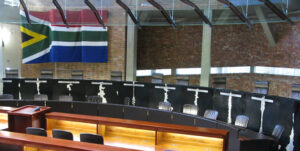

On 20 July 2025, the Constitutional Court will celebrate the 30th anniversary of its establishment.
The Constitutional Court, South Africa’s apex court was formally opened on 14 February 1995 by President Nelson Mandela. The moment marked a profound shift in South African legal and political life. The Court was to be a guardian of the Constitution and a beacon of justice in a country emerging from apartheid.
The first bench included some of the most respected legal minds in the country’s history such as Arthur Chaskalson, Pius Langa, Laurie Ackermann, Richard Goldstone, Tholie Madala, Ismail Mahomed, Yvonne Mokgoro, Kate O’Regan, Albie Sachs, Johann Kriegler and John Didcott.
On 15 February 1995, just a day after its ceremonial opening, the newly appointed justices took their seats to hear the Court’s first case, S v Makwanyane, which challenged the constitutionality of the death penalty. The Court unanimously found the death penalty unconstitutional, citing the rights to life, dignity, and freedom from cruel and inhuman punishment. Although S v Makwanyane was the first case heard, the first judgment delivered was in S v Zuma, where the Court struck down a section of the Criminal Procedure Act for violating the presumption of innocence.
On 21 March 2004, the Court moved to its permanent home at Constitutional Hill in Braamfontein. The building’s location is symbolic, situated at a former prison where many anti-apartheid activists were once held and near Hillbrow, a densely populated and diverse area, signifying openness and access to justice for all.
Over the past 30 years, the Court has handed down groundbreaking and sometimes controversial judgments. It has played a pivotal role in defining the parameters of our constitutional democracy.